

It is month four of a six-month package. The client has gone quiet, missed two calls, and just sent a one-line email: “This isn’t working for me, I’d like a refund for the sessions I didn’t use.” You open the agreement they signed, and realize there is no agreement. There is a PayPal invoice and a friendly email thread where you said “let’s do it.” Now you are negotiating your own refund policy in real time, with an unhappy client, from zero bargaining power.
That scene plays out in coaching practices every week, and it is almost always avoidable. The fix is a real client agreement, signed before the first session, that already answered the question.
On this page
- Why a handshake is now a liability
- The nine clauses every coaching agreement needs
- Scope of services
- Term, scheduling, and no-shows
- Payment and recurring billing
- Cancellation and refunds
- Confidentiality
- The coaching-is-not-therapy clause
- Intellectual property
- Liability and the no-guarantee clause
- Dispute resolution
- The same agreement, three ways
- Objections coaches raise about contracts
- FAQ
Why a handshake is now a liability
Coaching is not a side hustle anymore. The International Coaching Federation’s 2025 Global Coaching Study counted 122,974 coach practitioners worldwide and put annual revenue for the profession at roughly $5.34 billion, up from an estimated $2.849 billion in 2023 (ICF 2025 Global Coaching Study), close to double in two years. A large share of that money moves on “agreements” that are really an invoice and a DM. When the relationship is good, nobody reads the contract. It exists for the two percent of clients where things go sideways: the refund fight, the scope creep, the screenshotted private session. In every one of those, the person without a signed agreement loses, or pays a lawyer far more than the agreement would have cost to write.
Sources: practitioner count and revenue, ICF 2025 Global Coaching Study; “no state licenses coaches,” Cohen Healthcare Law; 35-states figure, Fenwick. General information, not legal advice.
A proper agreement sets expectations so disputes do not start, and gives you a clear footing if one does.
The nine clauses every coaching agreement needs
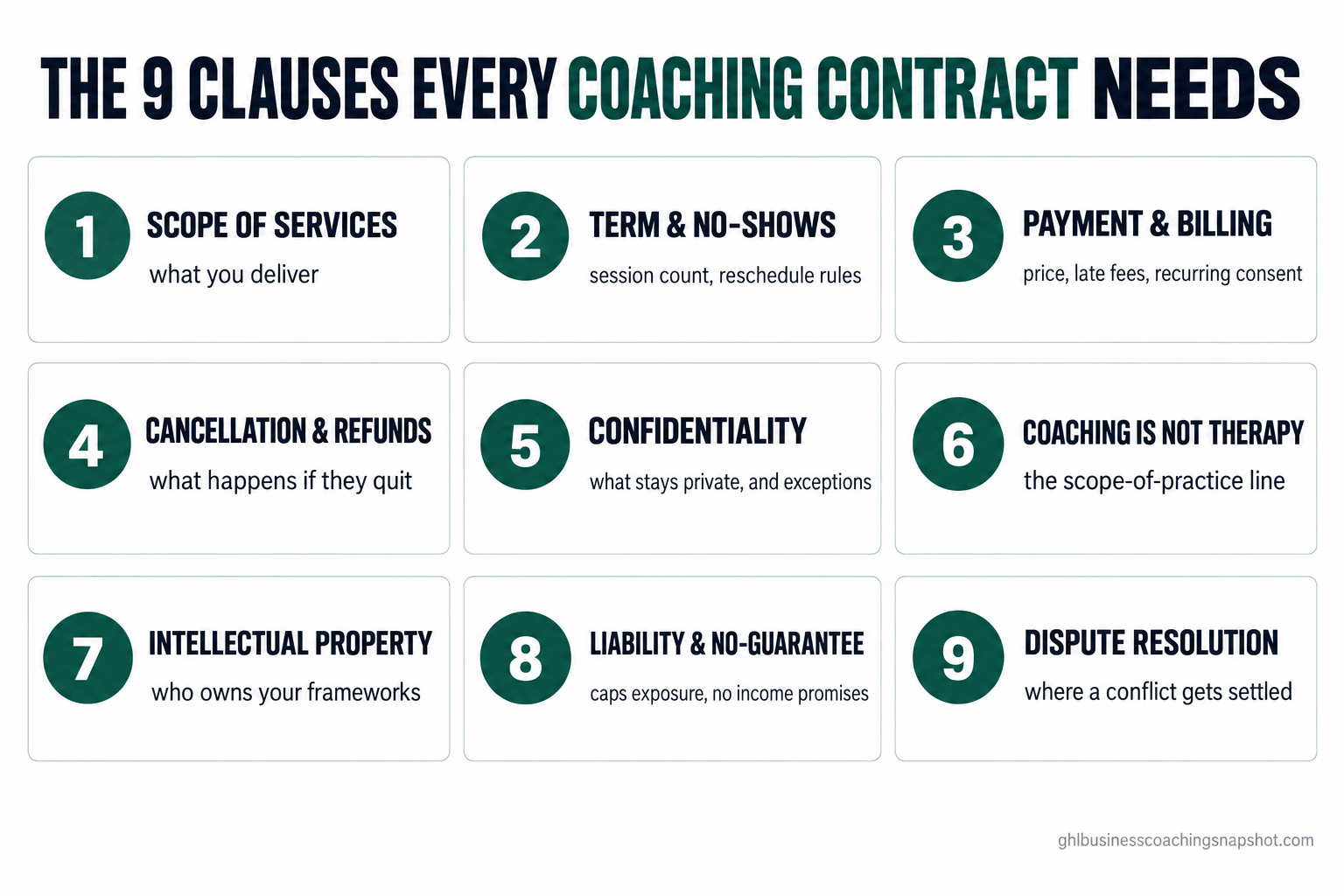
You do not need a forty-page contract. You need nine clauses that each earn their place: scope of services, term and no-shows, payment and billing, cancellation and refunds, confidentiality, the coaching-is-not-therapy line, intellectual property, liability plus a no-guarantee clause, and dispute resolution. Each one below comes with a plain sample you can adapt. They are a starting point, not a finished contract, and your final version needs a lawyer in your state.
1. Scope of services
This is the most important clause and the one coaches write worst. A good scope clause lists what the client gets in specifics: number of sessions, length, cadence, what async support looks like, and what is not included.
How it breaks: “Ongoing coaching and support” means something different to you and the client. They read it as unlimited; you meant two calls a month. Four weeks in they are texting at 10pm expecting a reply, and feeling shortchanged when they do not get one.
Sample language: “The Coach will provide [6] one-on-one sessions of [60] minutes each, delivered [weekly] by video call, over [12 weeks]. Between sessions the Client may send messages via [the client portal] and can expect a response within [2 business days]. Coaching does not include [done-for-you work, or legal, financial, medical, or clinical advice]. The engagement is complete when all sessions have been delivered or the term ends, whichever comes first.”
2. Term, scheduling, and no-shows
The scheduling and no-show rules save your calendar. Without a written reschedule policy, “can we just push it?” turns a six-session package into a nine-month saga.
How it breaks: The client misses a call with no notice, asks to reschedule, and you say yes. Do that three times and you have taught the client that your time is free to cancel. The policy protects the clients who show up.
Sample language: “This Agreement begins on [date] and continues until all sessions are delivered or until [end date]. Sessions must be rescheduled at least [24 hours] in advance. A session cancelled with less than [24 hours] notice, or a no-show, is forfeited and counts as delivered. Unused sessions expire [30 days] after the term ends and are not refundable.”
3. Payment and recurring billing
This clause states the price, schedule, accepted methods, what happens when a payment fails, and, if you bill monthly, explicit consent to the recurring charge. That last part is not optional. As of 2025, 35 states plus Washington, D.C. have automatic-renewal laws, and California’s amended law took effect July 1, 2025, requiring clear, separate consent to the renewal terms and an easy way to cancel (Fenwick, Sheppard Mullin). You sell nationally, so build to the strictest state and apply it everywhere.
How it breaks: A card expires, the charge fails silently, and the client keeps getting coached for free until you notice. Or a client forgets they are on a monthly retainer and month seven lands as a surprise charge and a chargeback. A clear recurring-consent line and a dunning process fix both, which we covered in why your coaching retainers are failing silently.
Sample language: “The fee is [$X], payable [in full up front, or in X monthly installments of $Y]. The Client authorizes the Coach to charge the card on file [monthly] until the term ends or the Client cancels in writing. If a payment fails, the Coach will notify the Client and may pause sessions until the balance is current. The Client may cancel a recurring plan at any time in writing, effective at the end of the current billing period.”
4. Cancellation and refunds
Here is the clause coaches get backwards. The instinct is “all sales final.” But a blanket no-refund term is one of the weaker things you can write, because consumer-protection rules in many states can override it and a card network may side with the client anyway. The strongest position is usually a short satisfaction window, then a pro-rata refund on undelivered sessions minus a stated cancellation fee.
How it breaks: No policy at all, which is the opening scene of this article. The client asks for a refund, you have nothing in writing, and you either eat the cost or look like the bad guy for refusing. Put the refund terms where the client sees them, and have them initial that section if the stakes are high.
Sample language: “If the Client is not satisfied within the first [14 days] and has attended no more than [one] session, the Client may request a full refund. After that window, fees for sessions already delivered are non-refundable. If the Client cancels a multi-session package early, the Coach will refund the pro-rata value of undelivered sessions, less a cancellation fee of [15%]. Refunds are processed within [10 business days] to the original payment method.”
5. Confidentiality
A confidentiality clause states what stays private, in both directions, and lists the exceptions: a credible threat of harm, a court order, or written permission to share. One honest line coaches forget is that video and phone sessions are not perfectly secure, so if you record, say so.
How it breaks: A client assumes everything is sealed, then learns you used an anonymized version of their story in a case study. Or the reverse: a client posts your frameworks or another member’s details from a group call, and you have no written rule to point to.
Sample language: “The Coach will keep Client information confidential and will not share it without the Client’s written consent, except where required by law, by court order, or where the Coach reasonably believes disclosure is necessary to prevent harm. The Client agrees to keep confidential any proprietary materials and, in group settings, anything shared by other participants. Both parties acknowledge that video and phone sessions carry inherent security risks.”
6. The coaching-is-not-therapy clause
This is the clause with the sharpest teeth and the one most coaches leave out. Every U.S. state licenses therapists and regulates who can diagnose or treat mental health conditions. No state licenses coaches (Cohen Healthcare Law). That sounds like freedom, but it is the trap: the line is drawn around what the work does, not what you call it, so a coach whose sessions start looking like treatment can be accused of practicing a licensed profession without a license. Avoiding the word “therapy” is not enough.
How it breaks: A client discloses depression or trauma, you keep “coaching” through it with no referral, and the sessions drift into clinical territory. If that client is later harmed or complains, the missing scope line makes you look like you were providing unlicensed treatment. This varies by state, so it is the clause most worth a local lawyer’s review.
Sample language: “Coaching is a partnership focused on the Client’s goals and growth. It is not therapy, psychotherapy, counseling, or medical, legal, or financial advice, and the Coach does not diagnose or treat any physical or mental health condition. If issues arise outside the scope of coaching, the Coach may recommend the Client consult a licensed professional, and the Client is responsible for seeking that care. The Client confirms they are not using coaching as a substitute for professional treatment.”
7. Intellectual property
Your frameworks, worksheets, decks, and recordings are assets. The IP clause says you still own them, grants the client a license to use them for their own learning, and stops them reselling or teaching your system as their own. This matters most for group and coach-the-coaches programs, where a student could launch a lightly rebranded copy of your curriculum six months later. With no IP clause you are arguing from scratch.
Sample language: “All materials, frameworks, worksheets, and recordings provided by the Coach remain the Coach’s intellectual property. The Client receives a personal, non-transferable license to use them for their own development, and may not copy, resell, distribute, teach, or create derivative works from them without the Coach’s written permission.”
8. Liability and the no-guarantee clause
Two things live here. A limitation of liability that caps your exposure, commonly at the total fees paid, and a no-guarantee clause that makes explicit you are not promising any specific result, income, or outcome.
That second piece connects to federal rules. If you sell a program that teaches people to make money, including most coach-the-coaches offers, your earnings claims fall under the FTC’s scrutiny. Its Business Opportunity Rule requires a reasonable basis and written substantiation for income claims, and in January 2025 the FTC proposed expanding it to cover business coaching (FTC, January 2025). A no-guarantee clause, matched by honest marketing, is part of staying clean, covered in the FTC rules coaches actually break.
How it breaks: The client does not get the result they hoped for, remembers a line from your sales page about “replacing your income,” and comes after you. If your agreement promised nothing and your marketing matched it, you are on solid ground. If your contract is silent and your sales page was loud, you are exposed.
Sample language: “Coaching outcomes depend on the Client’s own effort, decisions, and circumstances. The Coach makes no guarantee of any specific result, income, or outcome, and any examples shared are illustrative, not promises. To the fullest extent permitted by law, the Coach’s total liability under this Agreement is limited to the fees the Client actually paid, and the Coach is not liable for indirect, incidental, or consequential damages.”
9. Dispute resolution and governing law
The last clause decides where and how a conflict gets settled, and which state’s law applies. For most solo coaches, specifying your own state’s law and requiring mediation or arbitration before a lawsuit keeps a disagreement from becoming an expensive court case in the client’s home state, under rules you do not know.
Sample language: “This Agreement is governed by the laws of the State of [your state]. Before filing any legal action, the parties agree to attempt to resolve disputes through good-faith [mediation / arbitration] in [your county and state]. The prevailing party may be entitled to recover reasonable costs, where permitted by law.”
The same agreement, three ways
One template does not fit every program. The nine clauses stay the same; the emphasis and the risk shift with the modality, which is the axis that matters for your contract, not your city.
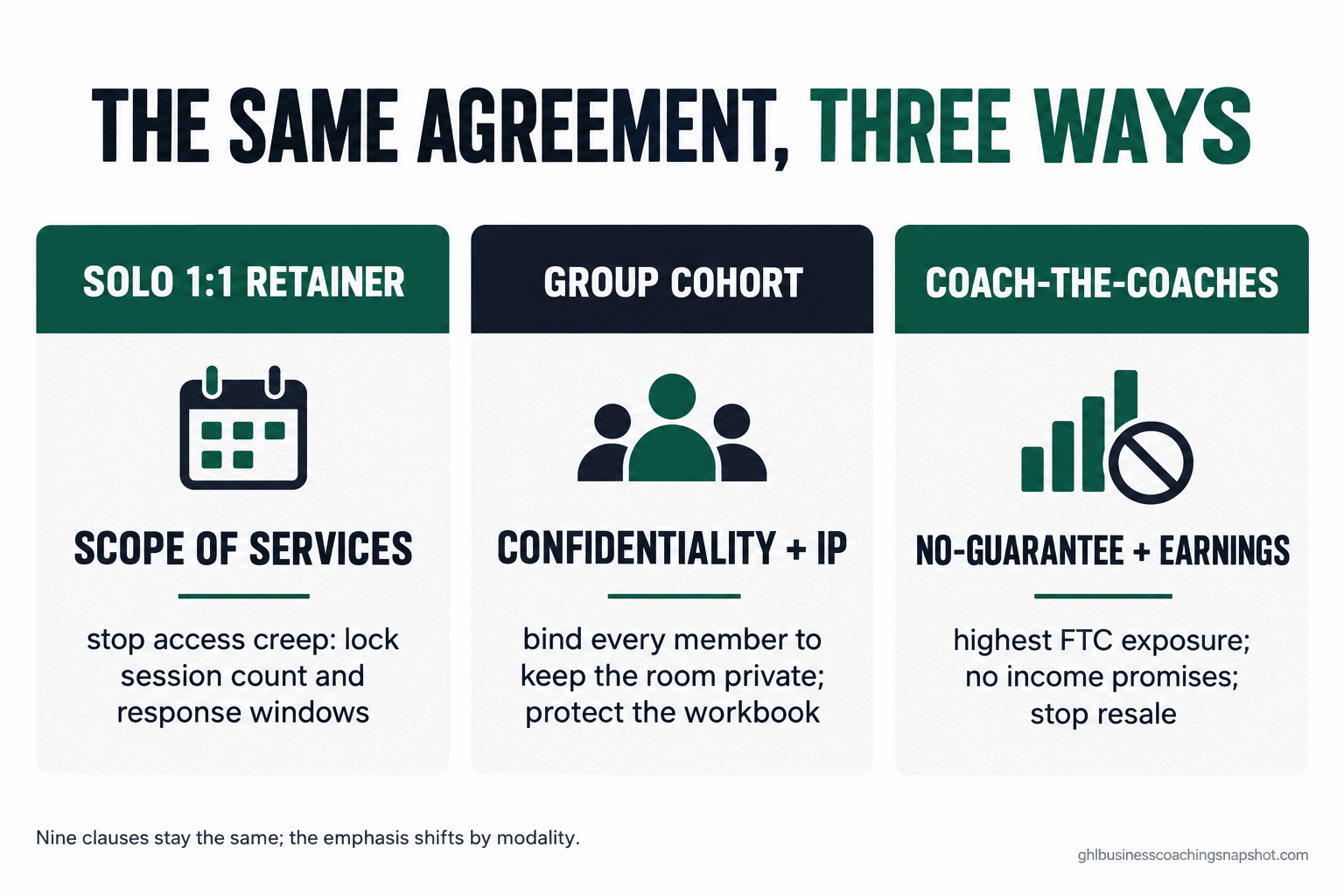
Solo 1:1 retainer. Keep it lean. The scope clause carries most of the weight, because the biggest risk is access creep: the client who turns a two-call month into an always-on text line. Nail down session count, response windows, and the reschedule policy.
Group cohort. Confidentiality becomes two-directional and load-bearing, because participants hear each other’s business, so the agreement has to bind every member to keep the room confidential. The IP clause gets heavier, and a conduct standard lets you remove a disruptive member without refunding the group.
Coach-the-coaches programs. The highest-exposure modality. The no-guarantee and earnings-disclaimer language is no longer optional; it is what keeps you out of FTC territory, because you are selling the promise of income. The IP clause has to explicitly stop students reselling your curriculum.
Estimated global coaching revenue, in billions of USD, from the ICF 2025 Global Coaching Study. A profession that nearly doubled in two years is worth putting on paper.
Objections coaches raise about contracts
“Isn’t a free template off the internet good enough?” A template is a fine skeleton and a terrible final document. The ones floating around are often written for another country or another decade, and rarely include the scope-of-practice line. Use one to understand the shape, then adapt every clause to your program and have a lawyer review it once. That costs less than a single refund fight.
“Won’t a formal contract scare off high-ticket clients?” Usually the opposite. Buyers paying $5K to $50K have signed real contracts before and expect one. A clean agreement signals that you run a real business, and the clients it scares off are often the ones who were going to be a problem anyway.
“I already use Kajabi or Paperbell, don’t they handle this?” Those tools collect a signature and process payment, which is the mechanism, not the content. They do not write your scope clause, refund policy, or scope-of-practice line. The platform delivers the agreement; you own what is in it. If you want the whole path from a discovery-call yes to a signed agreement and a first payment handled as one flow, that is the proposal, contract, and invoice system worth building once.
FAQ
Coaching client agreement: quick answers
What is the most important clause in a coaching agreement?
Scope of services does the most day-to-day work, because most disputes start as disagreements about what was included. The highest-risk clause is the coaching-is-not-therapy scope-of-practice line, because crossing it can get you accused of practicing a licensed profession without a license.
Can I just write 'no refunds' and be done with it?
You can, but a blanket no-refund term is often weaker than coaches assume: consumer-protection rules in many states can override it, and card networks may side with the client. A short satisfaction window plus a pro-rata refund on undelivered sessions minus a cancellation fee holds up better.
Do I legally need a coaching contract?
No state requires one, and no state licenses coaches. That is exactly why a written agreement matters: with no licensing framework behind you, your contract is your main source of clarity and protection. It is strongly advisable rather than legally mandatory.
Does a coaching agreement protect me from the coaching-versus-therapy problem?
It helps, but only if your practice matches it. A clause stating that coaching is not therapy, that you do not diagnose or treat conditions, and that you refer out protects you only if your sessions do not actually drift into treatment. This varies by state, so it is the clause most worth a local lawyer's review.
How is a coach-the-coaches contract different?
It carries the most legal exposure because it sells the promise of income, which pulls in the FTC's rules on earnings claims. The no-guarantee and earnings-disclaimer language becomes essential, the IP clause has to stop students reselling your curriculum, and your marketing has to match the contract.
Can my booking or course platform handle the agreement for me?
Tools like Kajabi, Paperbell, or a GoHighLevel setup capture a signature and process payment, but they do not write your clauses. They deliver the mechanism; you own the content of the scope, refund, and scope-of-practice terms. Draft and review the agreement, then let the platform fire it at the right moment.
The client in the opening scene does not have to be a crisis. With a signed agreement, that one-line refund email has a one-line answer: here is the policy you agreed to, here is what you are owed, here is how it gets processed. The agreement already did the hard part, back when everyone was happy.