

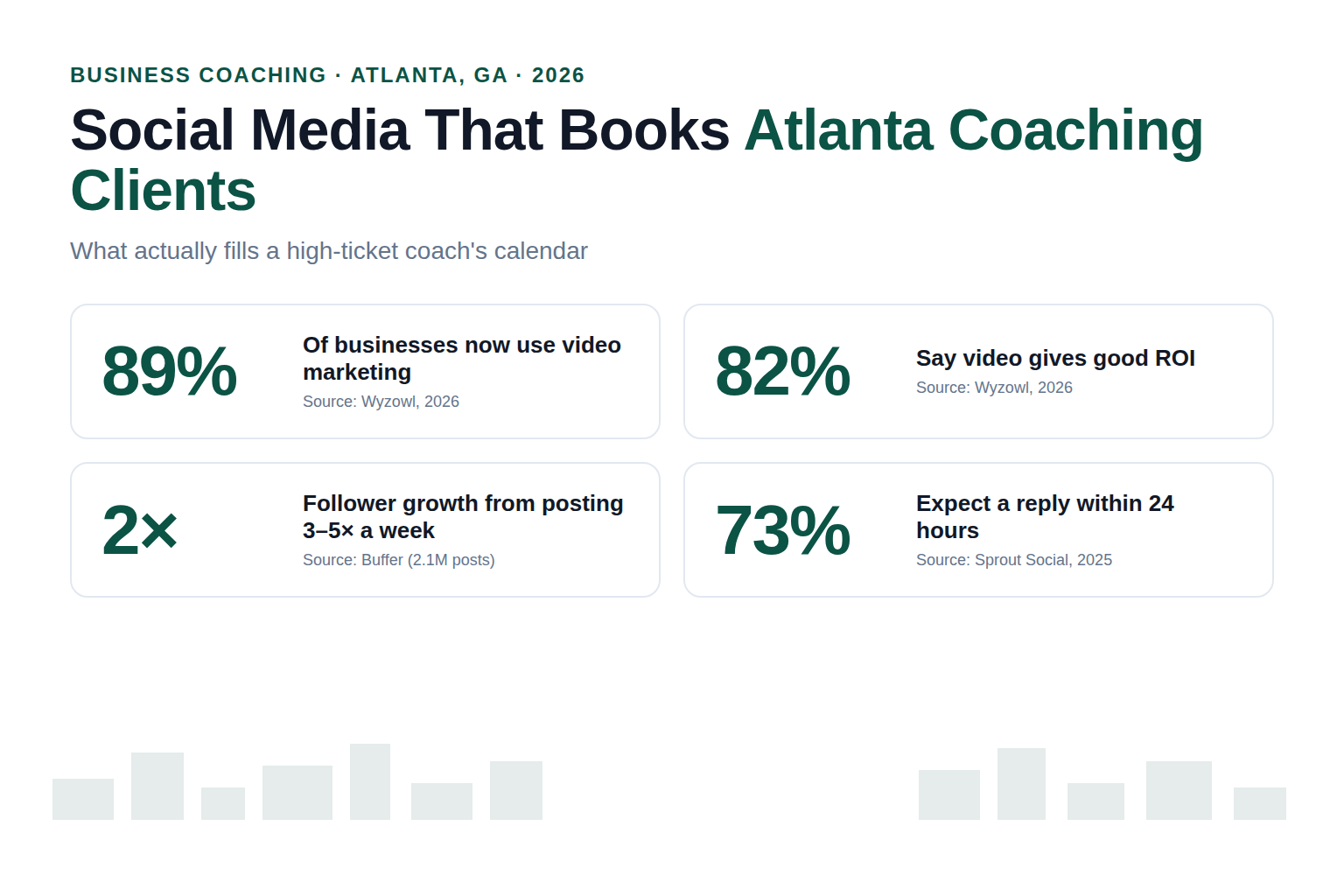
For a business coach in Atlanta selling a $5K–$50K engagement, social media isn’t about going viral — it’s about being the coach a founder already trusts before the discovery call. The metro Atlanta market is thick with executive, leadership, and startup coaches, and the buyer comparing three of you on a Tuesday night in Buckhead isn’t reading your sales page. They’re scrolling your feed, watching a 40-second Reel, and deciding whether you sound like someone who could actually help. This post is the honest, coach-specific answer to what actually works in social media marketing for a high-ticket Atlanta practice in 2026 — which formats earn attention, how often you really need to post, why reply speed quietly decides who gets hired, and when doing it yourself stops making sense.
The short answer: what actually works
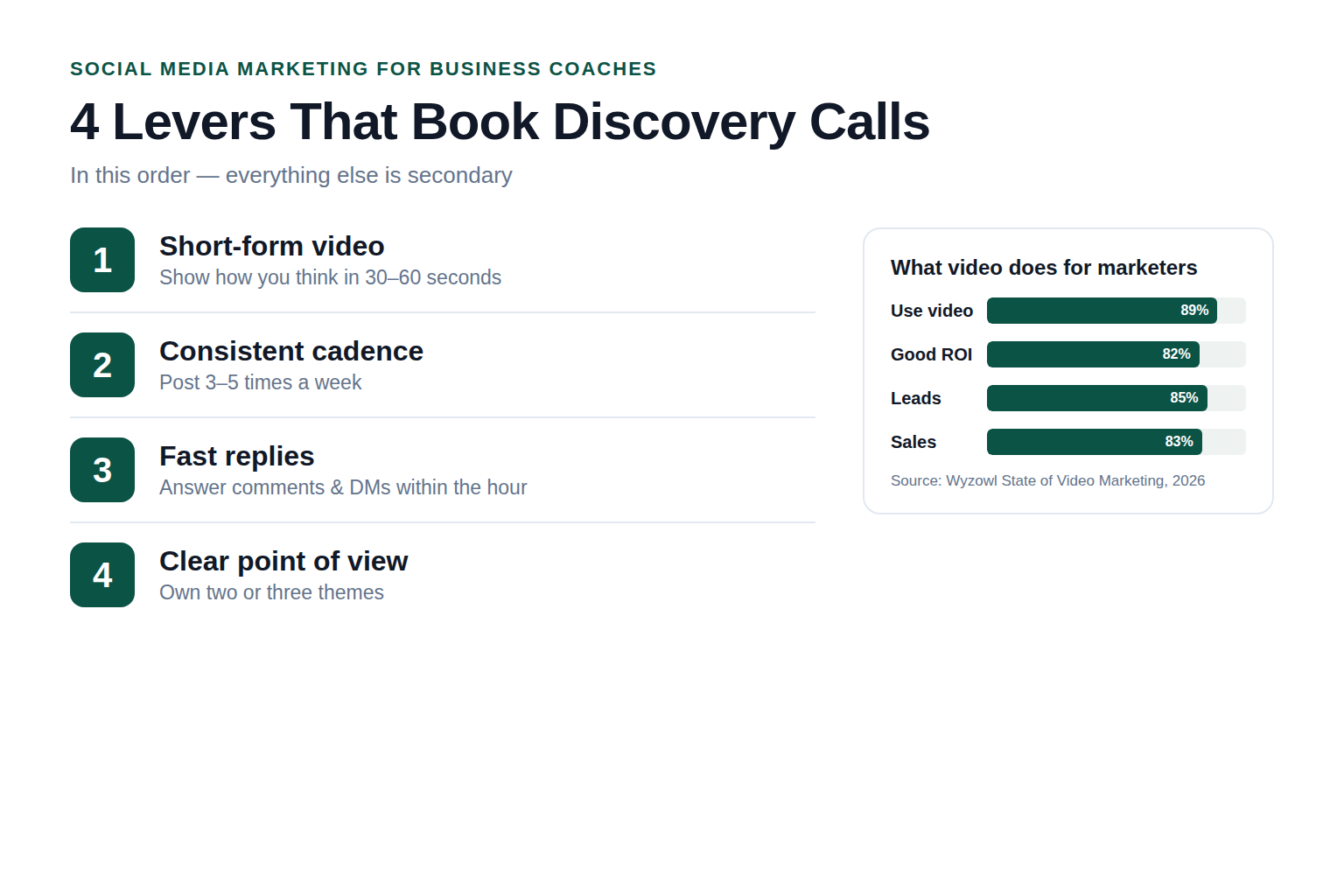
If you want social media to fill your calendar with discovery calls, four things do the heavy lifting — in this order:
- Short-form video that demonstrates how you think, not just what you offer.
- A consistent cadence (roughly 3–5 posts a week) so the algorithm and your audience both keep you top of mind.
- Fast replies to every comment and DM, because reply speed is where interest converts to a booked call.
- A recognizable point of view — thought leadership — so a five-figure buyer feels they already know you before the call.
Everything else (perfect graphics, trending audio, follower counts) is secondary. Notice what’s not on that list: virality. You do not need a breakout hit to build a coaching pipeline. You need to be visible, credible, and responsive — repeatedly. Here’s the data behind each lever, and why an Atlanta practice in particular can’t afford to skip them.
Sources: IBISWorld — US Business Coaching (2026); Wyzowl State of Video Marketing 2026.
Why Atlanta coaches feel this more than most
Atlanta is one of the strongest professional-services markets in the Southeast. It’s a corporate headquarters town — Fortune 500 anchors, a dense startup and tech scene around Midtown and Tech Square, and a deep bench of executives and founders across Buckhead, Alpharetta, Sandy Springs, and the wider metro. That’s a large, well-funded pool of buyers who can comfortably afford a five-figure coaching engagement.
It’s also crowded. Those same conditions attract coaches. When a Marietta founder or a Buckhead VP goes looking for an executive or business coach, they aren’t short on options — they’re overwhelmed by them. In a market where dozens of qualified coaches are one search away, the differentiator is rarely who’s the better coach on paper. It’s who the buyer has already seen show up, consistently, with something useful to say. Your social presence is how an Atlanta prospect narrows a long list down to the two or three people they’ll actually book a call with.
Short-form video is the highest-leverage format now
If you do one thing differently this quarter, make it video. Coaching is an intangible product — a buyer can’t inspect it the way they’d inspect a house or a haircut. Short-form video is the closest thing to a test drive: 30 to 60 seconds of you reframing a problem, answering a real client question, or naming the thing every founder gets wrong is worth more than any amount of polished copy, because it lets the buyer experience your thinking.
The data backs the instinct. Across marketers, 89% of businesses use video as a marketing tool, 82% say it delivers good ROI, 85% say it has helped them generate leads, and 83% say it directly increased sales (Wyzowl State of Video Marketing 2026). Just as important, 85% of people say they’ve been convinced to buy a product or service by watching a brand’s video (Wyzowl) — and short-form is the format audiences now reach for when they’re sizing up whether to trust you.
What marketers report about video, percent agreeing. Source: Wyzowl State of Video Marketing 2026.
For a coach, the winning video isn’t a highly produced brand film. It’s a talking-head Reel shot on your phone with a strong first line, one idea, and a clear takeaway. Repurpose it across Instagram Reels, TikTok, LinkedIn, YouTube Shorts, and Facebook and you get five placements from one recording. That’s the same instinct behind our organic playbooks for getting coaching clients on Instagram and on LinkedIn — different platforms, same core asset.
Consistency beats brilliance: the cadence data
The single most common reason a coach’s social presence underperforms isn’t bad content — it’s inconsistency. Three great posts in January and silence until April tells the algorithm and your audience the same thing: this account isn’t really here. The fix isn’t working harder on any one post. It’s showing up on a schedule.
Buffer’s research — an analysis of 2.1 million Instagram posts across roughly 102,000 accounts — found that accounts posting 3–5 times a week grow their follower base more than twice as fast as those posting just 1–2 times (Buffer). The same pattern holds on LinkedIn, where Buffer identifies a 2–5 posts-per-week “sweet spot” for distribution and engagement (Buffer). Cadence, not genius, is the lever most coaches are leaving unpulled.
Relative Instagram follower-growth rate by posting cadence (1–2×/week = baseline 1.0; 3–5×/week grows more than twice as fast). Source: Buffer, analysis of 2.1M posts across ~102K accounts.
Here’s the uncomfortable part: a real cadence — say one text post, one image, two carousels, and a Reel every week, cropped and captioned for every platform — is a genuine part-time job. It’s writing, design, filming, editing, scheduling, and publishing, week after week, during the exact hours you’re supposed to be coaching. That’s the tension every solo coach runs into, and it’s where most social plans quietly die.
The reply gap: where followers become discovery calls
Posting gets you seen. Replying gets you booked. And this is the step almost everyone underinvests in. When a prospect comments on your Reel or slides into your DMs with “how does your program work?”, that is a hand raised — a warm, in-market buyer signaling intent. Leave it for two days and the moment is gone.
The expectations are unforgiving. Per the 2025 Sprout Social Index, 73% of consumers expect a brand to respond within 24 hours, 76% say they value how quickly a brand responds to their needs, and 73% say that if a brand doesn’t respond on social, they’ll buy from a competitor the next time (Sprout Social). For a coach, “buy from a competitor” is literal: the DM you didn’t answer is a discovery call another Atlanta coach just booked.
How consumers react to social response speed. Source: 2025 Sprout Social Index.
This is the same principle behind our speed-to-lead system for coaches, applied to social: the fastest credible response usually wins the client. The catch is that you can’t personally watch every comment thread and inbox across nine platforms while you’re in session. That’s exactly the gap AI agents are built to close — a Facebook Messenger and Instagram DM responder plus a website AI chat widget that reply instantly, qualify the person, and offer a booking link, then hand off to you when there’s a real conversation to have.
A comment at 9pm on a Tuesday
A founder comments 'how much is your program?' on your Reel while you're finishing a session. You see it two days later, reply, and get nothing back. He booked a call with the coach who answered that night.
The agent replies in under a minute, answers the pricing question at a high level, asks one qualifying question, and drops your booking link. By the time you're out of session, there's a discovery call on your calendar.
What thought leadership does for high-ticket buyers
There’s a reason a $30,000 coaching engagement rarely closes on a cold pitch: the buyer has to trust your judgment before they’ll trust you with their business. Consistent, substantive content is how that trust gets built at scale — before you ever speak.
The B2B evidence is strong. The 2025 Edelman–LinkedIn B2B Thought Leadership Impact Report — a survey of thousands of management-level buyers — found that 90% of decision-makers and C-suite executives are more receptive to outreach from a company that consistently produces high-quality thought-leadership content (Edelman–LinkedIn). In the same research series, 73% of decision-makers said thought-leadership content is a more trustworthy basis for judging a firm’s competence than its marketing and product materials (Edelman–LinkedIn 2024). For a coach, that’s the whole ballgame — your feed is the competence signal an executive buyer is scanning for.
The practical version: pick two or three themes you want to be known for (say, “scaling past founder-led sales,” or “leadership under pressure”), and let almost everything you post ladder back to them. Depth and repetition on a narrow point of view beats breadth. It’s the same authority-building logic that makes SEO content for coaches compound over time — social just gets you there faster and with a face attached.
DIY vs done-for-you: the real math for a coach
Here’s the honest build-vs-buy calculation. To do social properly, you need to consistently produce short-form video, post 3–5 times a week across the platforms where your buyers actually are, and reply fast to every comment and DM. Done in-house, that’s effectively four roles: a content writer, a designer, a video editor, and a community manager. Hired separately in a market like Atlanta, that team runs several thousand dollars a month — and managing them is itself a job.
The DIY alternative isn’t free either; it’s paid in your hours, taken from the exact time blocks you’d rather spend coaching (and billing). Most coaches who try to run their own social end up in one of two failure modes: they post inconsistently and never build momentum, or they build momentum and then burn out and go dark. Neither fills a calendar.
What a done-for-you social system looks like
The version that actually works for a busy coach isn’t “hire a freelancer to post sometimes.” It’s a system that owns the whole loop: strategy, content, publishing, and the conversations that follow. In practice that means a team that plans your content, writes it in your coaching voice, designs the graphics, produces the Reels, publishes across every channel five days a week, and runs AI agents that reply to comments, DMs, and website chat instantly — booking discovery calls straight onto your calendar while you stay focused on clients.
That combination is exactly what our done-for-you social media service for coaches delivers: one text post, one image, two carousels, and one Reel every week, published five days a week across nine channels (Facebook, Instagram, Google Business Profile, LinkedIn, TikTok, YouTube, Pinterest, Threads, and Bluesky), plus three AI agents for comments, DMs, and web chat — from $397/month, white-label, no setup fees. For context, a designer, video editor, social manager, and community manager hired separately typically run $4,000–$8,000 a month. The point isn’t cheap content — it’s the consistency-and-speed system the data says wins, delivered without eating your coaching hours.
None of this replaces the thing that actually closes a high-ticket client: you, on the discovery call, being genuinely useful. Social media’s only job is to make sure enough of the right Atlanta buyers arrive at that call already trusting you. Post video, post consistently, reply fast, and hold a clear point of view — and the calendar takes care of itself. If content and conversations are the parts you keep meaning to get to and never do, that’s the signal to put a system on it. For where social fits alongside the rest of your automation stack, see AI for business coaches and, when you’re ready to spend where intent is highest, Facebook ads for coaches.
FAQ
What social media platforms should an Atlanta business coach focus on?
Start where your buyers already decide. For most business, executive, and startup coaches in Atlanta, that's LinkedIn (where founders and executives research and vet) and Instagram (where short-form video and personality build trust), with the same video repurposed to TikTok, YouTube Shorts, and Facebook. The winning move isn't picking one platform — it's producing one strong short-form video and cropping it for all of them. A done-for-you system posts to nine channels from a single content plan so you cover every surface without five times the work.
How often should a coach post on social media?
Aim for roughly 3–5 times a week. Buffer's analysis of 2.1 million Instagram posts across about 102,000 accounts found that posting 3–5 times a week more than doubles follower-growth rate versus posting 1–2 times, and it identifies a 2–5 posts-per-week sweet spot on LinkedIn. Consistency matters more than any single post being perfect — a steady cadence keeps you top of mind with both the algorithm and your audience. The hard part is sustaining it during the hours you're coaching, which is why many coaches move to a done-for-you cadence.
Does short-form video really matter for high-ticket coaching?
Yes — arguably more than for cheaper products, because coaching is intangible and buyers can't inspect it before they buy. Short-form video lets a prospect experience how you think in 30–60 seconds, which is the closest thing to a test drive. Across marketers, 89% of businesses use video, 82% report good ROI, and 85% say video has helped generate leads (Wyzowl, 2026), while 85% of people say they've been convinced to buy by watching a brand's video. For a coach, a phone-shot talking-head Reel with one sharp idea outperforms a polished brand film.
How fast do I need to reply to comments and DMs?
Fast — ideally within the hour, and definitely same-day. The 2025 Sprout Social Index found 73% of consumers expect a brand to respond within 24 hours and 73% say they'll buy from a competitor if a brand doesn't respond on social. A comment or DM asking about your program is a warm buyer raising a hand; if it sits for two days, the discovery call goes to whoever answered. Because no solo coach can watch every inbox across every platform while in session, AI agents for Messenger, Instagram DMs, and website chat are the practical way to hit that speed and book the call automatically.
Should a coach do social media themselves or hire it out?
Do it yourself if you're early-stage, still finding your voice, enjoy making content, and have the hours — you'll learn what resonates. Hire it out once your time is worth more in a coaching seat than behind a content calendar, and once inconsistency is costing you pipeline. Done properly, social requires a writer, designer, video editor, and community manager — several thousand dollars a month if hired separately in Atlanta. A done-for-you service bundles the content and the reply-and-booking agents from $397/month, which is usually the point where buying beats building.
How long before social media produces booked discovery calls?
Organic social compounds rather than spikes. Expect meaningful reach and inbound in roughly three to five months of consistent posting as the algorithms start surfacing your content to new audiences — sooner if a single Reel breaks out, which becomes more likely the more consistently you post across channels. What speeds up conversion at any stage is reply speed: answering comments and DMs instantly turns the audience you already have into calls now, while the reach builds underneath. Anyone promising overnight results from organic social isn't being honest.
Related reading
- How to Get Coaching Clients on Instagram — the organic playbook for turning Reels and DMs into booked calls.
- How to Get Coaching Clients on LinkedIn — where Atlanta’s executive and founder buyers actually vet coaches.
- Speed to Lead for Coaches — why the fastest credible reply usually wins the client, on every channel.
- SEO for Business Coaches — the slower-burn authority engine that pairs with social.
- AI for Business Coaches — where social and reply agents fit in the wider automation stack.
About the author. Tara Iyengar is a Funnel & Client-Experience Designer based in Raleigh, NC, who designs the client-facing surface of coaching practices — application forms, masterclass funnels, and the content-and-conversation cadences clients actually respond to. She came up writing copy for course launches before specializing in the systems that sit underneath them, and she’s opinionated about message timing.
Outcomes described on this site are illustrative, not guaranteed. The statistics cited are drawn from third-party research linked inline; social-media results depend on your offer, niche, audience, and how consistently you show up. Market-size and industry figures reflect the sources’ most recent published data at the time of writing.